

Essential Garage Tools Every DIY Mechanic Needs (and How to Use Them)
You don’t need a shop full of equipment to work on your own car — but you do need the right tools. A basic socket set and a jack get you started, but it’s the specialty tools that turn guesswork into actual diagnosis. Two of the most underrated tools in any garage cost less than a single shop diagnostic fee, and they pay for themselves the first time you use them. Here’s what every DIY mechanic should have on the bench, and how to use each one properly.
Diagnose First, Wrench Second
The most expensive repairs are the ones you do twice — replacing a part on a hunch, only to find the noise is still there. Pros don’t guess; they isolate. The golden rule of diagnosis: change one variable at a time, and prove the cause before you buy the part.
Start with your ears. A strange noise is your car’s way of telling you exactly where to look, if you know how to listen. Under-hood ticks, squeals, and knocks each have a signature, and the trick is pinpointing the source before it gets worse. That’s where a mechanic’s stethoscope comes in — the same tool your doctor uses, built for engines. Touch the probe to the valve cover, the alternator housing, the water pump, the power steering pump, and each suspect gets its own clear audio channel. The loudest point wins. A failing bearing, a dry idler pulley, or a noisy lifter goes from mystery to obvious in about thirty seconds.
A mechanic’s stethoscope costs less than most shop supplies and works on everything — engine, transmission, wheel bearings, even blower motors. Hold the probe firmly against each component while the engine runs (keep it clear of belts and fans), and move methodically from one suspect to the next. When you find the loudest spot, you’ve found your problem.
The Core Tools Every Garage Needs
Beyond the stethoscope, build your foundation with these. None of this is exotic — it’s the kit that covers 90% of DIY jobs:
Socket set (3/8″ drive). Metric and SAE, 6-point sockets preferred — they grip better and round off fewer fasteners. Add a couple of extensions and a universal joint.
Combination wrenches. Box end on one side, open end on the other. You’ll reach for these constantly.
Floor jack + jack stands. Never — never — work under a car supported only by a jack. Lift it, set it on stands, shake it. Then get under.
Torque wrench. Lug nuts, drain plugs, spark plugs — “tight enough” is how threads get stripped and wheels come loose. Your manual lists the specs; a torque wrench hits them.
OBD2 code reader. When a warning light comes on, this tells you where to start looking instead of guessing.
Power Your Accessories the Right Way
Adding a subwoofer, an amplifier, or auxiliary lighting is one of the most common DIY electrical jobs — and one of the most commonly botched. Undersized power wire starves your amplifier, overheats, and can blow fuses or worse. The right way is a proper gauge kit: heavy-gauge power cable from the battery, an in-line fuse holder mounted close to the battery, a solid ground connection to bare metal, and clean RCA and remote turn-on runs that stay separated from power wiring.
A complete amplifier wiring kit takes the guesswork out of it — 8-gauge power and ground cable, fuse holder with fuse, RCA interconnects, and remote wire, all matched to the job. Run the power cable through the firewall on the opposite side of the car from the RCAs, fuse within a foot of the battery, and ground to sanded bare metal with a ring terminal. Do that and your amp gets clean, stable power instead of a fire hazard.
What You’ll Need
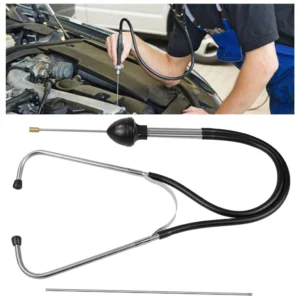
Auto Cylinder Stethoscope (Mechanic’s Diagnostic Stethoscope) — $14.99
Pinpoint engine, transmission, and accessory noises in seconds. Stainless probe with an insulated sound chamber blocks outside noise so each component gets its own audio channel. If it ticks, knocks, squeals, or whines, this finds it.
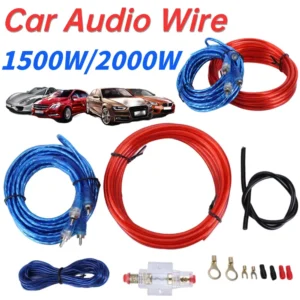
60 AMP 1500W/2000W Car Amplifier Wiring Kit (8GA) — $19.99
Everything for a proper amp or subwoofer install: 8-gauge power and ground cable, AGU fuse holder with 60A fuse, RCA interconnects, and remote turn-on wire. Sized right so your gear gets clean power — no voltage drop, no blown fuses.
Safety and Organization: The Unsexy Essentials
Two things separate a real garage from a pile of tools: safety gear and organization. Gloves, eye protection, and a fire extinguisher (ABC-rated, within arm’s reach of where you work) are non-negotiable. And organize early — a tool you can’t find is a tool you don’t own. Pegboard, a rolling cart, or even labeled bins beat the “pile on the workbench” method every time.
Keep a maintenance log too. A cheap notebook with dates, mileage, and what you did pays off when you sell the car, when a warranty question comes up, or when you’re trying to remember which filter you used last time.
Gear Up at DAutoHaus
The right tools don’t just make the job possible — they make it faster, safer, and cheaper than paying a shop. The diagnostic stethoscope and amplifier wiring kit above are both in stock and shipping to your door, alongside the shop supplies every garage runs through: gloves, hand cleaners, maintenance mats, and more. Running a small shop or keeping the whole family fleet on the road? Ask about bulk pricing. Questions about a tool or a job? Call or text us at (631) 800-9911 — we’re right here on Long Island.
DAutoHaus — your shop supply source. Long Island, NY. dautohaus.com — (631) 800-9911.